

CS 262 explores how design and technology influence and reshape human actions and behaviors. It also provides a deeper understanding of how human psychology can lead to the creation of interventions that positively impact individuals and society. The course equips students with research methods and tools to follow the complete “design thinking cycle,” emphasizing user research, behavior analysis, prototype design, and intervention evaluation. Technology plays a supporting role, as the course adopts a “people-first” approach. It combines lectures, in-class activities, case studies, and a semester-long community-focused project. Students gain hands-on experience working with industry experts and community members to design solutions in line with sustainable development goals, fostering collaboration, empathy, and a thorough understanding of technology’s impact on behavior.

CS360 provides a comprehensive introduction to software engineering (SE), covering the practical aspects of specifying, designing, developing, and testing software systems. The course explores software processes, agile methodologies, software specification, and system testing and maintenance. It also introduces the Unified Modeling Language (UML), a standard tool in SE for expressing designs. Students learn practical implementation in a programming language, documentation of technical and managerial aspects, effective presentations to various stakeholders, and ethical considerations in software system design and development in order to tackle SE challenges in the real-world.

CS322 provides a foundational understanding of brain function paradigms, exploring the brain’s functional organization and its significance in improving human-computer and machine interactions. It delves into organizational, cellular, and molecular neuroscience, covering perception, cognition, memory, and more. The course addresses the construction of consciousness and the scientific challenges it poses. Students will learn to formulate scientific questions, conduct research, and collaborate in multidisciplinary teams. The course fosters a fascination with neuroscience and empowers students to channel their curiosity into impactful scientific work, applicable in various fields beyond medicine. It combines lectures, activities, case studies, and projects, featuring insights from industry experts and local and international professionals, enhancing students’ understanding of sustainable development goals and real-world problem-solving.
CS666 is a graduate-level course in interactive systems and human-computer interaction research. It covers classical and cutting-edge topics, including virtual reality, gamification, wearable computing, ubiquitous and context-aware computing, social robotics, and ICT4D/HCI4D. By the end of the course, students will be well-versed in state-of-the-art research, able to conduct HCI-related research, and proficient in applying theoretical knowledge to the design, development, and evaluation of interactive systems. They will gain expertise in discussing key concepts, analyzing research literature, and critically reflecting on existing work, with the ability to design experiments and write technical or scientific papers to report their findings.

CS100 provides a conceptual and practical introduction to programming with a focus on programming rather than the particular choice of programming language, with general principles being brought out through the study of ‘C/C++’. This course will equip students with tools and techniques to solve a given problem programmatically. It also equips students with the necessary critical thinking, communication, and problem solving skills that will prepare students for future programming courses.
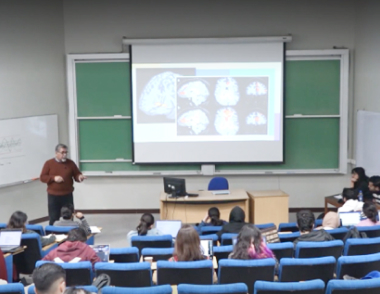
HCI explores the application of design principles from physical objects to digital media and interactive systems, and emphasizes concepts like usability and utility. Students gain practical experience in the user centered design cycle’s phases: user research, design, and evaluation in order to apply theories and design principles to real-world product design, addressing constraints and challenges. It equips them with the necessary critical thinking skills, enabling them to observe and analyze user behavior creatively and identify potential issues while being mindful of research and design ethics. They will become adept at designing digital interactive systems and effectively communicating with diverse stakeholders. Ultimately, students will be well-prepared to critique existing user interfaces, challenge their design instincts, and create user-friendly solutions.